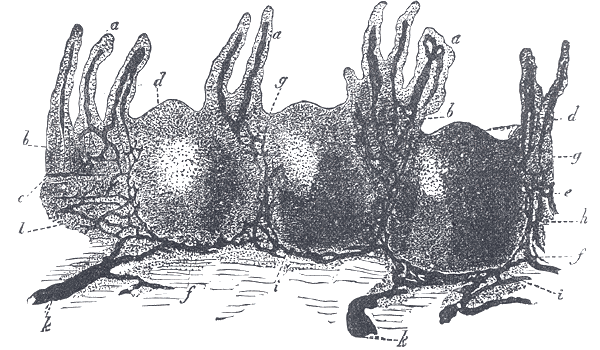
You are defended by two immune systems that work on opposite principles. The innate system is inherited whole, responds within minutes, treats every pathogen it recognises the same way, and behaves identically on the thousandth exposure as on the first. The adaptive system is built during your lifetime, takes days to get going, and is exquisitely specific to one target — but it remembers, so the second encounter is faster and stronger than the first. Neither is sufficient alone. Almost every useful thing the immune system does depends on the older system deciding there is a problem and handing the specific work to the newer one.
Where it is, and what it looks like
The innate system begins with barriers that are not usually thought of as immune at all: intact skin and mucous membranes, the acid of the stomach, the mucus and beating cilia of the airway, the flushing of tears and urine, and the resident microbiota competing with newcomers for space and nutrients. Behind those sit the cells — neutrophils, macrophages, dendritic cells, natural killer cells, mast cells and eosinophils — and the soluble systems, chiefly the complement cascade of around thirty plasma proteins and the acute phase proteins made by the liver. None of these require prior exposure, and none of them improve with practice.
The adaptive system is built from lymphocytes and lives in the lymphoid organs. The primary lymphoid organs are where lymphocytes are made and taught: the bone marrow, where all lymphocytes originate and B cells mature, and the thymus, where T cells mature and are ruthlessly selected. The secondary lymphoid organs are where they meet antigen: lymph nodes strung along the lymphatic vessels, the spleen filtering blood rather than lymph, the tonsils, and the mucosa-associated lymphoid tissue including the Peyer's patches of the small intestine. The architecture matters, because an adaptive response requires a rare lymphocyte and a rare antigen to find each other, and the secondary organs exist to make that meeting likely.
Two populations of lymphocyte do the specific work. B cells recognise antigen directly in its native form through their surface immunoglobulin, and when activated they differentiate into plasma cells that secrete antibody — humoral immunity, which is effective against extracellular bacteria, toxins and free virus. T cells recognise only fragments of antigen displayed on the surface of other cells by MHC molecules, and they split into two arms: CD8 cytotoxic T cells, which kill infected or abnormal cells displaying antigen on MHC class I, and CD4 helper T cells, which read antigen on MHC class II and direct almost everything else, including the B cell response.
What it does
The innate system recognises classes rather than individuals. Its receptors, of which the toll-like receptors are the best known, are encoded in the germline and detect pathogen-associated molecular patterns — bacterial lipopolysaccharide, flagellin, double-stranded RNA, unmethylated CpG DNA — which are conserved molecules that microbes cannot easily discard, and which the body does not make. Recognition triggers a stereotyped response: phagocytosis, cytokine release, complement activation and the vascular changes of inflammation, with dilated leaky capillaries producing the classical redness, heat, swelling and pain, and neutrophils arriving within minutes. Fever follows from interleukin-1 and interleukin-6 acting on the hypothalamus.
The adaptive system recognises individuals. Each lymphocyte carries a receptor of a single specificity, generated before it ever meets an antigen by randomly recombining gene segments — V, D and J — to produce a repertoire estimated in the hundreds of millions to billions of distinct receptors. When a pathogen arrives, the few lymphocytes whose receptors happen to fit it are selected and made to proliferate, which is clonal selection. That is why the primary response takes seven to ten days: the useful cells have to be found and multiplied from almost nothing. B cells then improve their antibodies during the response through somatic hypermutation and affinity maturation in germinal centres, and switch antibody class from IgM to IgG, IgA or IgE depending on the instructions their helper T cells give them.
The two systems are joined by the antigen-presenting cell, and the dendritic cell is the crucial one. It samples material in the tissues, engulfs it, digests it, migrates to the draining lymph node, and displays fragments on MHC class II to CD4 T cells — while also displaying costimulatory molecules whose expression depends on whether its innate receptors detected a genuine pathogen. That second signal is what prevents the adaptive system from responding to harmless material, and it is why adjuvants, which stimulate innate receptors, are needed to make most vaccines work. Antibody then feeds back to the innate system, coating pathogens for phagocytosis and activating complement, so the older system does much of the killing that the newer system has directed.
The cells that build it
The single most important product of the adaptive response is memory. After an infection is cleared, most of the expanded clone dies by apoptosis, but a subset persists for years or decades as memory B and T cells that are more numerous than the original naive precursors, are already class-switched and affinity-matured, and require less stimulation to activate. A secondary response therefore begins within one to three days rather than seven to ten, produces mainly high-affinity IgG rather than IgM, and reaches a far higher antibody titre. That single property is the entire basis of vaccination: a vaccine is a way of paying the cost of the primary response without paying the cost of the disease. The price of a randomly generated receptor repertoire is that some of those receptors will fit the body's own molecules, and the immune system therefore spends enormous effort on tolerance. In the thymus, developing T cells that bind self-MHC too weakly die by neglect and those that bind self-antigen too strongly are deleted, a process that destroys the great majority of thymocytes produced. Peripheral tolerance provides a second layer, through regulatory T cells, through anergy in lymphocytes that receive antigen without costimulation, and through the deletion of self-reactive B cells in the marrow. Autoimmune disease is what happens when those mechanisms fail.
How to recognise it on a slide
Secondary lymphoid organs share a structure that is unusually informative once you can read it, because their compartments correspond exactly to the two lymphocyte populations. In a lymph node, the outer cortex contains rounded follicles that are the B cell zone; a primary follicle is a small uniform ball of resting cells, while a secondary follicle has a pale germinal centre — large dividing B cells, tingible-body macrophages containing the debris of apoptotic cells, and a surrounding darker mantle of small resting lymphocytes pushed aside. A germinal centre is direct visual evidence of an active adaptive response. The paracortex between the follicles and the medulla is the T cell zone, and it expands in viral infections while the follicles expand in bacterial ones. The medulla holds cords of plasma cells and antibody, drained by sinuses. The spleen follows the same logic with different geography: white pulp forms sleeves of lymphoid tissue around central arterioles, with the periarteriolar lymphoid sheath as the T cell zone and follicles budding off it as the B cell zone, all set in the red pulp that filters blood. Peyer's patches in the ileum are the same arrangement again, sitting in the gut wall beneath a specialised epithelium containing M cells that sample the lumen directly.
When it goes wrong
Failure of either system produces a characteristic infection pattern, and the pattern points to the defect. Neutrophil defects, whether from chemotherapy, leukaemia or inherited disorders, produce bacterial and fungal infections of skin, mouth and lung; fever in a neutropenic patient is an emergency. Complement deficiency, particularly of the terminal components, produces recurrent Neisseria infections. Antibody deficiency, as in common variable immunodeficiency, produces recurrent infections with encapsulated bacteria such as pneumococcus and Haemophilus, because antibody is needed to opsonise a capsule. T cell defects, of which HIV infection destroying CD4 cells is the great example, produce opportunistic infections — Pneumocystis, cytomegalovirus, mycobacteria, fungi — and certain cancers, because the cellular arm controls intracellular pathogens and abnormal cells.
Immunity can also be turned against the wrong target. Hypersensitivity reactions are conventionally divided into four types: type I, immediate IgE-mediated reactions, from hay fever to anaphylaxis; type II, antibody directed at antigens on the body's own cells, as in autoimmune haemolytic anaemia; type III, immune complex deposition, as in systemic lupus erythematosus; and type IV, delayed T cell-mediated reactions, as in contact dermatitis and the tuberculin skin test. Autoimmune disease is a loss of self-tolerance, whether organ-specific, as in type 1 diabetes and Hashimoto's thyroiditis, or systemic, as in lupus and rheumatoid arthritis.
Understanding the two systems explains most of what modern immunological medicine does. Vaccines exploit adaptive memory and generally need an adjuvant to trigger innate receptors first. Transplant rejection is largely T cells recognising foreign MHC, which is why immunosuppressants target T cell activation and why tissue matching matters. Checkpoint inhibitors release the brakes that normally restrain T cells, allowing them to attack tumours, at the cost of autoimmune side effects. And after splenectomy, patients lose a major site for responding to encapsulated organisms, which is why they need specific vaccination and often lifelong prophylactic antibiotics.
Common questions about the immune system
What is the difference between innate and adaptive immunity?
Innate immunity is inherited, responds within minutes, recognises broad classes of pathogen through germline-encoded receptors, and behaves identically every time. It includes barriers, neutrophils, macrophages, natural killer cells and complement. Adaptive immunity is built during life from lymphocytes with randomly generated, highly specific receptors; it takes seven to ten days to mount a first response, but it forms memory, so subsequent responses are faster and stronger. B cells make antibody; T cells kill infected cells and direct the response.
What is the difference between B cells and T cells?
B cells recognise antigen directly in its native form and, once activated, become plasma cells that secrete antibody — effective against extracellular bacteria, toxins and free virus. T cells recognise only processed antigen fragments displayed by MHC molecules on other cells. CD8 cytotoxic T cells kill infected or abnormal cells presenting on MHC class I; CD4 helper T cells read MHC class II on antigen-presenting cells and coordinate the rest of the response, including telling B cells which antibody class to make.
How do vaccines work?
A vaccine presents the adaptive immune system with a harmless version of a pathogen or one of its components, so it mounts a primary response and forms memory B and T cells without the disease. On real exposure, those memory cells respond within one to three days with high-affinity IgG rather than in seven to ten days with IgM. Most vaccines also contain an adjuvant, which stimulates innate receptors so that antigen-presenting cells provide the costimulation the adaptive response requires.
Which infections suggest which part of the immune system has failed?
The pattern is diagnostic. Recurrent bacterial and fungal infections of the skin, mouth and lung suggest a neutrophil problem. Recurrent infections with encapsulated bacteria such as pneumococcus suggest an antibody or spleen problem, because a capsule needs antibody to be opsonised. Opportunistic infections such as Pneumocystis, cytomegalovirus and mycobacteria suggest a T cell problem, classically HIV. Recurrent Neisseria infections suggest a deficiency of the terminal complement components.
Selected references
- Murphy K, Weaver C. Janeway's Immunobiology. 10th ed. W. W. Norton; 2022.
- Abbas AK, Lichtman AH, Pillai S. Cellular and Molecular Immunology. 10th ed. Elsevier; 2021.
- Ross MH, Pawlina W. Histology: A Text and Atlas. 8th ed. Wolters Kluwer; 2020.
- Iwasaki A, Medzhitov R. Control of adaptive immunity by the innate immune system. Nature Immunology. 2015;16(4):343-353.
- Farber DL, Yudanin NA, Restifo NP. Human memory T cells: generation, compartmentalization and homeostasis. Nature Reviews Immunology. 2014;14(1):24-35.
- Kumar V, Abbas AK, Aster JC. Robbins and Cotran Pathologic Basis of Disease. 10th ed. Elsevier; 2021.
Medical disclaimer. This article is written for education and general understanding. It is not medical advice and cannot replace assessment by a qualified healthcare professional. If you have symptoms or health concerns, speak with a clinician. Read the full disclaimer.