The endocrine system is the body's slow control network, and it works on a principle exactly opposite to the nervous system. A nerve sends a private message down a dedicated wire to one target in milliseconds. A gland releases a hormone into the blood, where it reaches every cell in the body — and only the cells carrying the right receptor respond. That broadcast-with-an-address design is why hormones can coordinate slow, whole-body processes like growth, metabolism and reproduction that no amount of wiring could manage, and why the effects take minutes to years rather than milliseconds.
The parts, and how they fit together
The classical endocrine glands are those whose main job is secretion into the blood. The pituitary sits in the sella turcica beneath the hypothalamus and is often called the master gland, though it is really the hypothalamus's intermediary. The thyroid wraps the front of the trachea and sets metabolic rate; four parathyroid glands on its posterior surface control calcium. The adrenal glands cap the kidneys, with a cortex making steroids and a medulla making adrenaline. The pineal gland secretes melatonin and tracks the light-dark cycle. The thymus, prominent in childhood and shrinking thereafter, matures T lymphocytes.
Several organs are endocrine as a second job, and these matter more clinically than their secondary status suggests. The pancreas has islets of Langerhans scattered through exocrine tissue, secreting insulin, glucagon and somatostatin. The gonads produce oestrogen, progesterone and testosterone alongside gametes. The kidney releases erythropoietin and renin and performs the final activation of vitamin D. The heart secretes natriuretic peptides when its chambers are stretched. Adipose tissue releases leptin and adiponectin. Even the gut lining releases a dozen hormones controlling digestion and appetite — so the endocrine system is less a set of organs than a function distributed across the body.
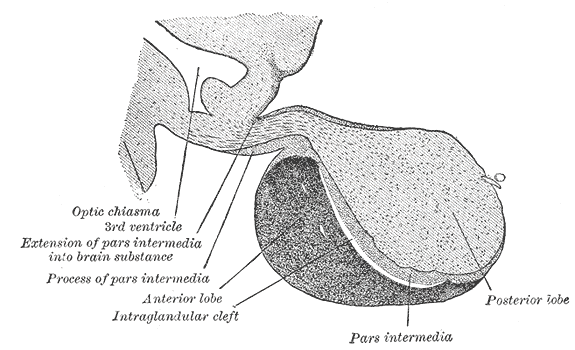
The organising structure is the hypothalamic-pituitary axis, and almost all endocrine disease is best located on it. The hypothalamus releases small hormones into a private portal circulation running down the pituitary stalk to the anterior pituitary, which responds by secreting trophic hormones — TSH, ACTH, LH, FSH, growth hormone and prolactin — into the general circulation. These act on the peripheral glands, which release the final hormone. The posterior pituitary is different in kind: it is not glandular at all but nervous tissue, the axon terminals of hypothalamic neurons that make antidiuretic hormone and oxytocin in the hypothalamus and simply store and release them here.
How the system works
Hormones fall into two classes and the class determines almost everything about how they behave. Peptide and protein hormones — insulin, growth hormone, the pituitary trophic hormones — are water-soluble, travel free in plasma, cannot cross the cell membrane, and therefore bind receptors on the cell surface. That triggers a second messenger cascade using cyclic AMP, calcium or kinase phosphorylation, which amplifies the signal enormously and produces effects within seconds to minutes by modifying proteins that already exist. Because they are water-soluble they are cleared quickly, with half-lives of minutes, and because they are proteins they cannot be given by mouth — which is why insulin is injected.
Steroid and thyroid hormones do the opposite. They are lipid-soluble, so they need carrier proteins to travel in blood, and only the small unbound fraction is active. They pass straight through the cell membrane and bind receptors in the cytoplasm or nucleus, and the resulting complex binds DNA and changes gene transcription. That means the effect requires new protein synthesis, so it takes hours to days to appear and persists after the hormone is gone. Their half-lives are long — hours for cortisol, about a week for thyroxine — and being lipid-soluble they can be taken by mouth, which is why steroids and levothyroxine are tablets.
Negative feedback controls almost all of it, and understanding it makes endocrine disease straightforward to reason about. In the thyroid axis, hypothalamic TRH drives pituitary TSH, which drives thyroid hormone release, and thyroid hormone then inhibits both the hypothalamus and pituitary. So a failing thyroid gland produces low thyroid hormone with a high TSH, while a failing pituitary produces low thyroid hormone with a low TSH — which is exactly how the two are told apart in a blood test. The same logic applies to cortisol and ACTH, and to the sex hormones with LH and FSH. Positive feedback is rare and deliberately unstable, used only where a process needs to run to completion: the LH surge that triggers ovulation, and oxytocin in labour, where uterine contraction pushes the fetal head onto the cervix, whose stretch releases more oxytocin.
The cells that do the work
What decides whether a cell responds to a hormone is not the hormone but the receptor, and this is the single most useful idea in endocrinology. Every cell is bathed in every hormone; only those expressing the matching receptor react, and the same hormone can produce opposite effects in different tissues depending on receptor subtype — adrenaline constricts vessels in the gut through alpha-1 receptors and dilates them in skeletal muscle through beta-2. Cells adjust their sensitivity by changing receptor number: chronic overstimulation causes downregulation, which is why continuous rather than pulsatile GnRH shuts down the gonadal axis and is used therapeutically in prostate cancer, and chronic understimulation causes upregulation and supersensitivity. Endocrine cells themselves are built for secretion, packed with rough endoplasmic reticulum and Golgi in peptide-secreting glands, or with smooth endoplasmic reticulum, mitochondria with tubular cristae and lipid droplets in steroid-secreting ones — an appearance so distinctive that a pathologist can tell which type of hormone a tumour makes from its ultrastructure alone. Endocrine tissue is also unusually vascular, since the product goes straight into blood, and its cells sit in cords or follicles against fenestrated capillaries rather than around a duct.
Under the microscope
Endocrine glands are recognised by what they lack: no ducts, and a rich capillary network right against the secretory cells. The thyroid is unmistakable and unique in the body, being the only gland that stores its product outside the cells — spherical follicles lined by cuboidal epithelium and filled with pink colloid, with parafollicular C cells producing calcitonin sitting between follicles. The height of the follicular cells reports activity: flat and inactive when suppressed, tall and columnar with scalloped colloid when driven hard. The adrenal cortex shows three zones from the capsule inward: zona glomerulosa in whorls making aldosterone, zona fasciculata in long radial columns of pale lipid-filled spongiocytes making cortisol, and zona reticularis in an anastomosing network making androgens, with the darker, basophilic chromaffin cells of the medulla at the centre. The pituitary anterior lobe is a mixture of acidophils, basophils and pale chromophobes in cords between sinusoids, while the posterior lobe looks like nervous tissue because it is, showing axons and pituicytes rather than glandular cells. Pancreatic islets appear as pale, well-circumscribed clusters standing out against the darker exocrine acini around them.
When the system fails
Endocrine disease is nearly always too much hormone, too little, or resistance to it, and the axis tells you where the fault lies. Hypothyroidism — fatigue, weight gain, cold intolerance, constipation, slow reflexes — is usually autoimmune Hashimoto's thyroiditis, and shows low thyroxine with high TSH because the pituitary is shouting at a gland that cannot answer. Hyperthyroidism — weight loss despite appetite, heat intolerance, tremor, palpitations, anxiety — is usually Graves' disease, in which an antibody mimics TSH at its receptor, so thyroxine is high and TSH suppressed. Reading the pair of results, rather than either alone, is what localises the problem.
Diabetes mellitus is the commonest endocrine disease and the two types differ in mechanism rather than severity. Type 1 is autoimmune destruction of pancreatic beta cells, so there is no insulin at all; it presents in younger patients with thirst, polyuria, weight loss and a risk of ketoacidosis, and requires insulin from the start. Type 2 is insulin resistance with progressive beta cell failure, strongly linked to visceral adiposity, and often silent until a complication appears. The long-term damage in both is vascular — retinopathy, nephropathy, neuropathy from small vessel disease, and accelerated atherosclerosis in the large vessels.
Adrenal and pituitary disease illustrate the same feedback logic. Cushing's syndrome is cortisol excess — central obesity, moon face, thin skin, purple striae, muscle wasting, hypertension, glucose intolerance — and by far the commonest cause is prescribed steroids, which also suppress the patient's own axis, so stopping them abruptly can precipitate an adrenal crisis. Addison's disease is the opposite, primary adrenal failure with fatigue, weight loss, low blood pressure and hyperpigmentation, the pigmentation occurring precisely because unrestrained ACTH production also stimulates melanocytes. Pituitary adenomas cause trouble in three ways at once: by secreting a hormone, by compressing the rest of the gland, and by pressing on the optic chiasm above to produce a characteristic loss of both outer visual fields.
Common questions about the endocrine system
What does the endocrine system do?
It coordinates slow, whole-body processes using chemical messengers carried in the blood: metabolism, growth, the stress response, reproduction, fluid and electrolyte balance, and calcium regulation. Unlike the nervous system, which sends fast private signals to specific targets, hormones reach every cell and act only on those carrying the right receptor — so effects unfold over minutes to years rather than milliseconds.
What are the main endocrine glands?
The dedicated glands are the pituitary, pineal, thyroid, four parathyroids, the adrenals and the thymus. Several organs are endocrine as a secondary role: the pancreas through its islets, the ovaries and testes, the kidney through erythropoietin and renin, the heart through natriuretic peptides, adipose tissue through leptin, and the gut lining through a dozen digestive and appetite hormones.
How does negative feedback work in the endocrine system?
The final hormone inhibits the glands that stimulated its release. Hypothalamic TRH drives pituitary TSH, which drives thyroid hormone, and thyroid hormone then suppresses both TRH and TSH — so the level self-corrects. This is why measuring the trophic hormone alongside the final one localises disease: a failed thyroid gives low thyroxine with high TSH, while a failed pituitary gives low thyroxine with low TSH.
What is the difference between steroid and peptide hormones?
Peptide hormones such as insulin are water-soluble, bind receptors on the cell surface, work through second messengers, act within seconds to minutes, have short half-lives, and must be injected because digestion would destroy them. Steroid and thyroid hormones are lipid-soluble, travel bound to carrier proteins, pass through the membrane to bind receptors that alter gene transcription, take hours to days to act, last far longer, and can be taken as tablets.
Selected references
- Hall JE, Hall ME. Guyton and Hall Textbook of Medical Physiology. 14th ed. Elsevier; 2021.
- Melmed S, Auchus RJ, Goldfine AB, Koenig RJ, Rosen CJ, eds. Williams Textbook of Endocrinology. 14th ed. Elsevier; 2020.
- Ross MH, Pawlina W. Histology: A Text and Atlas. 8th ed. Wolters Kluwer; 2020.
- Nussey S, Whitehead S. Endocrinology: An Integrated Approach. BIOS Scientific Publishers; 2001.
- Kumar V, Abbas AK, Aster JC. Robbins and Cotran Pathologic Basis of Disease. 10th ed. Elsevier; 2021.
- Standring S, ed. Gray's Anatomy: The Anatomical Basis of Clinical Practice. 42nd ed. Elsevier; 2021.
Medical disclaimer. This article is written for education and general understanding. It is not medical advice and cannot replace assessment by a qualified healthcare professional. If you have symptoms or health concerns, speak with a clinician. Read the full disclaimer.